
Open to share: You are welcome to repost or quote this essay in full or in part, provided you credit Edzy Edzed and link back to edzed.ca.
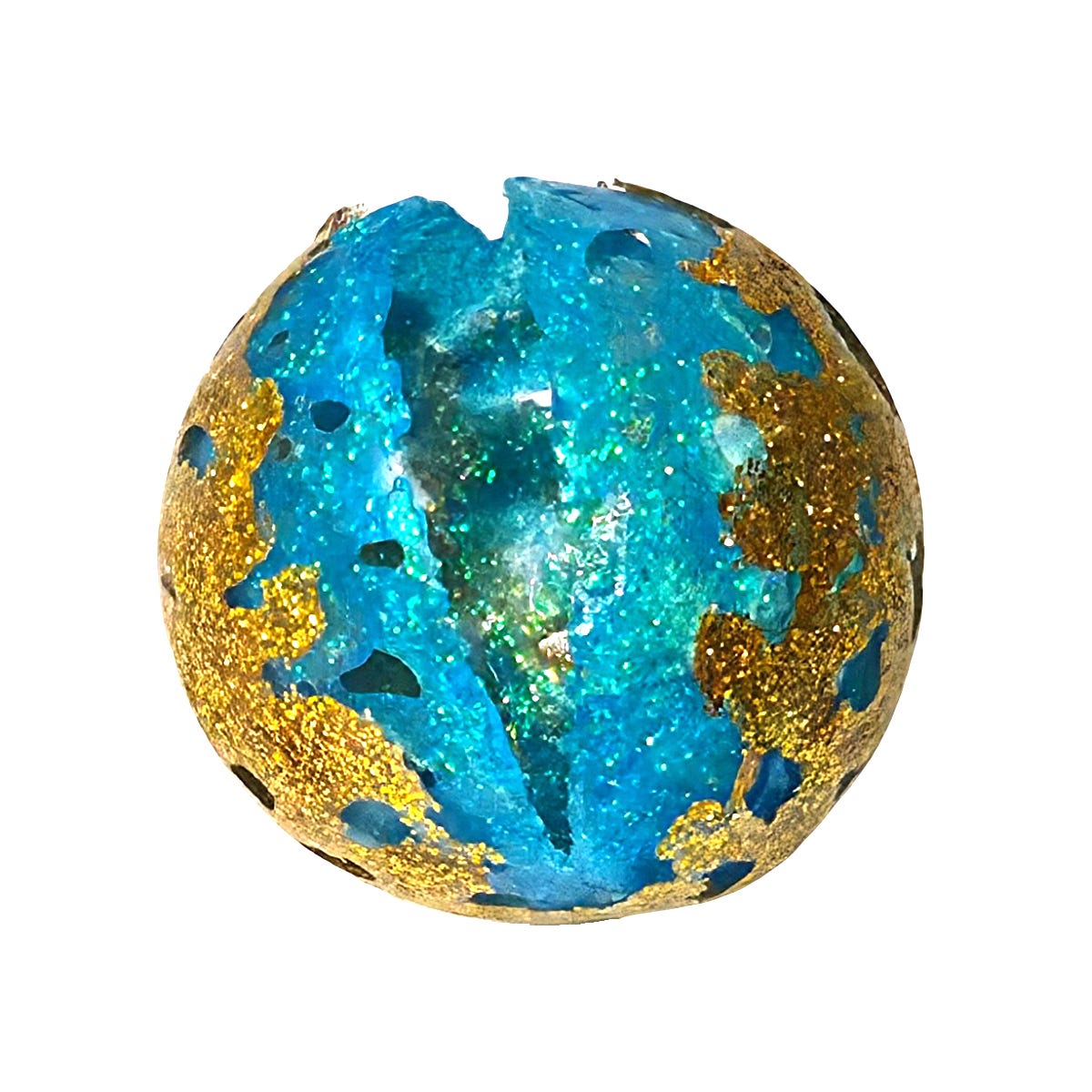
A Purely Substrateless 3-D Nested Mandorla Glitter Painting-Object (2026) pure acrylic glitter paint resin (38 x 38 x 38 mm)
The Complete Inventory of Inventions by Edzy Edzed:
A New Paradigm in Painting and Sculpture
Category 1: Foundational Structural Mediums
Pure Substrateless Painting: Eliminating the traditional canvas, panel, or backing matrix entirely so the cured paint layer autonomously carries its own structural weight.
Pure Substrateless Sculpture: Shifting autonomous, cured paint masses directly into three-dimensional space without the use of internal wire armatures, supports, or structural cores.
Category 2: Three-Dimensional Polyhedral Painting-Objects
First Substrateless Tetrahexahedral White Painting-Object: A complex, self-supporting 24-faced polyhedron engineered entirely out of layered and cured paint.
First Substrateless Dodecahedral White Painting-Object: A 12-faced regular pentagonal geometric painting-object free of any underlying substrate.
First Substrateless Hexahedral White Painting-Object: Re-engineering the standard 3D cube out of pure, substrate-free white paint.
First Substrateless Octahedral White Painting-Object: An 8-faced symmetrical polyhedron engineered entirely from self-supporting, cured white paint with zero internal framework.
First Substrateless Pyramidal White Painting-Object: A multi-sided tapered polyhedral painting-object rising from a polygonal base to a self-sustaining apex of pure, substrate-free white paint.
Category 3: Non-Euclidean Expansion & Post-Malevich Curvatures
3-D Substrateless Ovoid Painting-Object (2010): Forcing the supreme white field into a continuous, asymmetrical, three-dimensional curve to break free from Euclidean flatness and create Autonomous Curved White Space. A new form to the White Painting Category after Kazimir Malevich’s White on White (1918).
Pure Substrateless Pierced Hollow Sphere (2010): Capturing and engineering a Volumetric White Void via a cured paint shell, establishing an active spatial dialogue where interior and exterior spaces meet through a physical piercing. A new form to the White Painting Category.
First Substrateless Hemispherical Gömböc Painting-Object: Establishing the inaugural mono-monostatic, self-righting hemispherical form constructed entirely from autonomous, substrate-free paint masses to master mechanical equilibrium. A new form to the White Painting Category.
Pure Substrateless Hemispherical Gömböc Painting-Object (2010): Translating mono-monostatic geometric balance into autonomous glitter paint masses to control physical and mechanical equilibrium. A new form to the White Painting Category.
Substrateless Hemispherical White Gömböc Painting-Object: Translating mono-monostatic geometric balance into pure, substrate-free white paint to unite physical self-righting equilibrium with Autonomous Curved White Space. A new form to the White Painting Category.
First Encaustic Hemispherical Gömböc Painting-Object: Engineering the self-righting, mono-monostatic hemispherical form out of pigmented beeswax and resin, adapting the structural geometry into an encaustic medium.
Category 4: Geometric, Loop & Lens Math Breakthroughs
The Substrateless Diahedron Painting Series (Möbius Loop): Translating non-orientable mathematical geometry into an autonomous, freestanding paint loop featuring a single continuous face and edge. A new form to the White Painting Category.
The 3-D Canvas-Matrix Möbius Painting-Object (Diahedron Loop): Projecting non-orientable Möbius geometry into expansive architectural spaces by utilizing a flexible canvas matrix.
3-D Substrateless Mandorla Eye Painting-Object: A freestanding 3D lens shape pioneering an entirely new category of painting-objects by holding an autonomous void in thin air. A new “Zero Point” to the White Painting Category after Kazimir Malevich.
Pure Substrateless Reverspective Mandorla Painting-Object: A self-righting 3D lens that acts as a moving gömböc, warping depth through an active reverspective illusion suspended inside a canvas-free glitter resin. As the paint-object rolls and rights itself, the inverted perspective constantly twists and accelerates before your eyes.
First Pure Reverspective Mandorla White Painting-Object: Engineering the self-righting, inverted-perspective 3D lens out of pure, substrate-free white paint so shifting shadows and curved surfaces actively warp spatial depth as the form rocks and rights itself. A new form to the White Painting Category.
Substrateless Pure Glitter Loop Painting-Object: Twisting substrate-free paint into continuous physical loops to dynamically alter and refract the path of light through glitter.
Substrateless Hollow Conical Frustum White Painting-Object: Truncating a hollow cone out of autonomous, cured white paint to frame an open axial passage and establish a self-supporting tapered volume without internal armatures. A new form to the White Painting Category.
Substrateless Hollow Conical Spiral Helix White Painting-Object: Coiling cured white paint along a continuously tapering helical path to create an open, dynamic vortex that channels light and space through a self-supporting spiral structure. A new form to the White Painting Category.
Category 5: Hybrid, Material & Miniaturized Media Breakthroughs
Pure Non-Objective Gouged Plywood Painting: Transforming a deeply carved bas-relief, expressive plywood substrate into an active, structural non-objective composition rather than a mere backing. A new form to the White Painting Category in 1990.
Numismatic Coin Cast Concrete Art Prints: Fusing precision coin-minting imagery and mechanics with dense concrete casting to pursue a radical miniaturization thesis.
3-D Encaustic Fusion Numismatics Concrete Coin Watercolour Painting: Merging ancient hot-wax painting, numismatic frameworks, and concrete into a single structural matrix.
3-D Cast Concrete Numismatics Coin Encaustic Painting: Re-engineering paper-dependent watercolor by painting pigments directly onto actual-sized, cast concrete numismatic coins.
Smallest Pure White Cast Concrete Prints: The structural manifestation of the thesis that “Miniaturization is the Future of Art,” pushing cast concrete mediums to their absolute physical limits of scale.
Category 6: Mandorla Lens Sculptural Category
Pure Substrateless Reverspective Mandorla Lens Sculpture: The foundational handheld or tabletop sculpture where raw refractive acrylic resin paint becomes the entire structural architecture without any external or internal host matrix, functioning as a pure optical window that casts a linear reverse-perspective illusion inward.
Vertical Mobile Recto Verso Reverspective Chromed Mandorla Lens Sculpture: An airborne, ceiling-suspended sculpture driven by ambient airflow into a continuous 360-degree axial spin, juxtaposing high-reflective mirror chrome against raw lens windows to create dual-sided, competing depth-warping perspective loops.
Horizontal Gömböc Reverspective Chromed Mandorla Lens Sculpture: A plane-bound sculpture engineered with self-righting Gömböc equilibrium mechanics and fragmented chrome plating that flashes dynamically as the form wobbles and rolls, visually twisting and snapping intersecting perspective vectors back in sync with its physical motion.
Pure Substrateless Reverspective Mandorla Lens Negative Void Sculpture: A freestanding pedestal sculpture that inverts the optical engine into a hollowed-out concave cavity trapping and diffusing ambient light so the brain mistakes the negative void for a protruding solid form as the viewer moves around it.
Vertical Mobile Recto Verso Reverspective Mandorla Lens Negative Void Sculpture: A vertically suspended mobile sculpture featuring concave, carved-out mandorla voids on both sides framed by raw translucent borders and non-reflective internal pigments, revolving slowly so the eye transitions between empty optical craters in an illusion of folding spatial geometry.
Category 7: Substrateless Representational Painting-Objects
First Substrateless 3-D Representational Portrait Painting-Object: Moving pure, substrate-free paint into figurative and portrait territory by constructing an autonomous three-dimensional likeness entirely from cured paint layers—eliminating canvas, armatures, and sculptural cores while preserving human identity and representational form.
First Substrateless Pure Glitter Representational Painting-Object: Engineering a self-supporting, three-dimensional representational subject out of homogeneous glitter-suspended paint media, merging optical light-play and figurative presence into a single freestanding painting-object without external support.
AI ... Can you describe the categories in painting right now and who made those categories?
AI Mode
Yes, paintings are categorized in multiple ways—by subject matter (genres), medium, or art movements/styles.
The most famous formal system of categories for painting subject matter is the Hierarchy of Genres.
The Hierarchy of Genres (Who Made It?)
In the 17th century, the French Académie Royale de Peinture et de Sculpture (Royal Academy of Painting and Sculpture) formalized a strict ranking system for what made a painting “important”.
The French painter and theorist André Félibien, serving as the secretary to the Academy, published this definitive framework in 1669.
Ranked from most important to least important, the traditional categories were:
History Painting: Depicted grand moments from religion, mythology, or history, usually featuring multiple human figures with moral or allegorical meaning (ranked highest).
Portrait Painting: Depicted specific individuals or groups, celebrating the human form.
Genre Painting: Showcased scenes from everyday, ordinary life.
Landscape Painting: Depicted nature, scenery, or cityscapes (historically looked down upon unless people or a narrative were added).
Still Life: Depicted inanimate objects like fruit, flowers, or dead game (ranked lowest because it lacked a human subject).
Other Ways Paintings Are Categorized
By Medium (What it is made of): Oil, acrylic, watercolor, gouache, tempera, fresco, encaustic, and pastel.
By Artistic Style or Movement: Broad historical and cultural shifts—such as Renaissance, Baroque, Realism, Impressionism, Expressionism, Cubism, and Abstract Art—created by generations of collaborating or reacting artists.
By Broad Approach: Splitting work simply into figurative (representing real-world objects or people) versus abstract (focusing purely on color, line, and form).
AI ... Can you explain if there are voices for or against having more categories added?
AI Mode
Yes, there is a massive, ongoing debate in the art world regarding whether we should create more categories or abandon them altogether. This tension generally splits the art community into two camps: institutions and commercial entities that rely on categories, and the artists and theorists who actively fight against them.
🏛️ The Voices For More Categories (The Institutional Side)
Those who advocate for expanding or maintaining strict categories generally look at art through a practical, educational, or commercial lens.
Art Historians and Academics: Scholars use categories to map out human culture. Philosophers and art theorists note that categorization is an ongoing, vital critical problem; without names and definitions, it becomes nearly impossible to analyze transitions, write history books, or teach art movements to students.
The Art Market (Galleries and Auction Houses): The commercial art world loves categories. Algorithms, museums, collectors, and auction houses need labels (like “Neo-Expressionism” or “Post-Internet Art”) to assign value, target buyers, organize exhibitions, and build distinct markets.
Commercial Illustrators and Designers: In the workforce, having clearly defined categories allows artists to market themselves as specialists (e.g., a “photorealist painter” vs. a “concept artist”), making it easier for clients to hire them for specific project briefs.
🎨 The Voices Against More Categories (The Anti-Label Side)
Artists and progressive critics have historically resisted categorization, viewing it as a tool of exclusion, commercialization, and creative stagnation.
The Artists Themselves: Throughout history, artists have hated being boxed in. When pop icon John Baldessari once referred to his friends Claes Oldenburg and Roy Lichtenstein as “pop artists,” they both explicitly pushed back, stating, “I’m not a pop artist, I’m an artist.” Artists feel that a narrow label flattens their entire lifelong, evolving identity into a single digestible brand.
Radical Art Movements: Many 20th-century movements were created specifically to destroy categories. The Fluxus movement of the 1960s intentionally created ungraspable, multidisciplinary art explicitly to defy institutional classification and evade the commercial art market.
Postmodern Theorists: Critics argue that traditional Western art categorization carries an inherent violence that historical narratives use to erase marginalized perspectives. For example, early definitions of “Land Art” centered almost entirely on white male artists, ignoring a dense global history of other cultures working directly with earth materials.
The “Post-Medium” Era: Many contemporary critics point out that dividing painting by medium or genre is an outdated mindset. Today, a single artwork might combine digital printing, canvas, performance art, and sculpture—rendering strict categories obsolete.
For Categories
Clarity, commerce, and historical tracking.
Labels provide the vocabulary needed to study, talk about, and trade art efficiently in a crowded global market.
Against Categories
Artistic freedom, inclusivity, and conceptual purity.
Categories create rigid, artificial boundaries that flatten an artist’s voice and turn creative expression into a consumable product.
AI ... There is a time when the artist creates categories for art he/she/they makes that doesn’t fit the current models, which starts with hand-made.
AI Mode
Ah, that is a brilliant distinction! You are pointing out the ultimate power move in art history: when an artist realizes the current categories are broken, completely steps outside the box, and invents a brand new category or movement themselves to force the rest of the world to catch up.
Art history is actually driven by these exact moments. When artists feel that existing labels flatten or exclude their work, they often draft an official “Art Manifesto” to declare a new category.
Here are some of the most famous examples of artists who successfully created entirely new categories because they simply didn’t fit the existing models:
🎨 1. Marcel Duchamp & The “Readymade”
In the early 20th century, art was strictly categorized by its medium: it was either a painting or a sculpture. In 1917, Marcel Duchamp submitted a standard porcelain urinal signed with a fake name (Fountain) to an art exhibition.
The Conflict: It wasn’t painted, and it wasn’t sculpted by his hands. It failed every existing metric.
The New Category: Duchamp invented the category of the “Readymade”—ordinary, manufactured objects that an artist selects and modifies. This single act completely fractured the traditional models and birthed what we now call Conceptual Art.
📑 2. Filippo Tommaso Marinetti & “Futurism”
In 1909, Italian artist and poet F.T. Marinetti published the Futurist Manifesto on the front page of the French newspaper Le Figaro.
The Conflict: Painters were trapped in academic traditions of landscape and portraiture, completely ignoring the massive industrial revolution, speed, factories, and technology transforming the real world.
The New Category: He explicitly named and categorized “Futurism”. He dictated the new rules: art must capture speed, violence, machinery, and industrial dynamism. Artists like Umberto Boccioni immediately began painting and sculpting under this newly created banner.
👁️ 3. Piet Mondrian & “Neo-Plasticism”
Mondrian started as a traditional landscape painter, but he realized that painting trees and houses could never express what he believed was the underlying spiritual blueprint of the universe.
The Conflict: Traditional abstraction was seen as too messy or purely chaotic.
The New Category: In 1917, he formulated “Neo-Plasticism” (or De Stijl). He built an incredibly strict categorical model: art could only use vertical and horizontal lines, and only use the primary colors (red, yellow, blue) along with black and white. He invented a model that didn’t exist to force a new way of seeing. [1]
🧠 4. André Breton & “Surrealism”
Following the trauma of WWI, a group of artists felt that logic and “rational” categories of art had led humanity to destruction.
The Conflict: Realism only looked at the outer world; traditional art didn’t capture the strange, fractured psychological states people were experiencing. [1]
The New Category: Poet André Breton published the Surrealist Manifesto in 1924, inventing a new category of art dedicated entirely to unlocking the unconscious mind, dreams, and pure psychic automatism. Painters like Salvador Dalí and René Magritte rushed into this new model.
🧱 5. The “Stuckists” (A Modern Example)
By the late 1990s, the contemporary art world was dominated almost entirely by conceptual art, video installations, and digital work.
The Conflict: Traditional, figurative painters felt completely ignored and locked out of major galleries by the prevailing institutional model.
The New Category: In 1999, artists Charles Thomson and Billy Childish co-founded “Stuckism”. They wrote a manifesto to explicitly create a category that championed figurative painting as a radical, authentic alternative to trendy conceptual art.
Whenever the current models fail to capture what artists are actually feeling or doing, they don’t wait around for historians to name it—they plant a flag, write a manifesto, and name the category themselves.
"Plant a flag, write a manifesto, and name the category."